
I didn’t realise there was so much interest in the Canon 200-400mm f4 lens as Nikon has had one for years and it’s already in its second generation. I borrowed the lens from CPS (Canon Professional Services) when I was shooting the Australian Open two weeks ago and can confirm Joshua Holko’s review from his video that the image quality is excellent, and on par with shooting with a 300mm or 400mm prime lens. Here are some sample images all shot on a Canon 1D X body, including the one of Sloane Stephens that was on the front page of Sports Illustrated’s web site when she defeated Serena Williams:
1/1600 at f/4.0, ISO 1000 at 400mm

1/1600 at f/4.0, ISO 6400 at 400mm

1/1600 at f/5.6, ISO 2000 at 420mm (with 1.4x)

Here’s the image of Sloane Stephens on SI:

Blog
The Canon 200-400mm lens
Shooting the Australian Open
I shot my third Australian Open for Cal Sport Media. Images are here.
My images also wound up on their partners’ sites: Associated Press AP, Belga News Agency, ZUMApress, Newscom, Newspix, and Sipa Press.
Looking forward to 2014.

Getting beyond 12 frames per second
The Canon 1D X can shoot at 12 frames per second (fps) and the Nikon D4 at 10 fps with complete auto focus. They can both shoot a bit faster with no auto focus after the first frame but that’s not much use in most sports situations.
At the Australian Open last week I shot some matches with a Nikon V2. This is a new class of camera called “mirrorless” because it doesn’t have a mirror and prism in the camera body that diverts the image from the lens to the viewfinder. Instead, these cameras are more like video cameras where the image from the camera lens hits the sensor which is then displayed on an electronic view finder. Since these mirrorless cameras don’t have a mirror that need to be retracted by a mechanism they can capture images much faster than traditional digital SLRs like the 1Dx and D4. How fast? I was capturing images at 60 frames per second. Full size, in RAW format.
This camera’s ability to capture images at this frame rate compares to the top of the line Canon 1D C which captures video at “4K” resolution meaning a horizontal resolution of 4000 pixels. The 1D C records at 4096 × 2160 which is the Digital Camera Initiatives 4K standard. There’s an extensive review of this camera’s ability by United Film Works and extracting frames from the video in wedding and portrait scenarios.
Another camera, the GoPro Hero3 Black also records in DCI 4K format. The 1D C captures at 24 fps and the GoPro at 15 fps compared the the Nikon at 60 fps and the Nikon’s image size is 4608 x 3072, larger than 4K, and every one of these images is in RAW format compared with the Canon 1D C which is in motion JPEG (GoPro unclear). The financial comparison is also enlightening – Canon 1D C is over USD $10,000 and the GoPro at $400 and Nikon V2 at $800.
I wanted to see how the Nikon V2 goes in shooting Grand Slam level tennis players. Tennis is often said to be one of the most demanding sports to shoot. Unpredictable movement, need for split second timing, and harsh lighting. If the camera can get good sequences shooting tennis then it might be a killer camera for the weekend sports photographer. So here are two sequences shot with the V2 using the 70-200mm f2.8 lens with the FT-1 adapter. This is equivalent to a 189-540mm zoom on a full frame sensor. These have been cropped and scaled down to 1280×720 for YouTube, but remember they are from full frame RAW files, rather than video. Make sure you watch them in HD:
Overall, I was very pleased with the images with the major caveat of having to essentially pre-focus and wait for the player to be stationary. Image sequences where the subject was moving were largely out of focus – it was random luck whether you got any usable images. In good daylight at ISO 200 the RAW images can be tweaked to be as good as the D3, Nikon’s previous generation of pro-DSLR.
Here are two images that have a wide dynamic range and detail in the shadows and highlights:


However, there is one major difference with all these cameras and the current flagship Nikon D4 and Canon 1D X cameras. When shooting 4K video on the 1D C or 60fps in the case of the V2 there is no continuous autofocus. Video cameras have continuous AF but not these cameras – at this stage. There is a further problem with the Nikon V2 when shooting 60fps: the screen goes black when the shutter is pressed and it is recording. So these images were effective pre-focused and they work because the player is basically stationary.
So, the current pros and cons of these three cameras:
- Nikon V2: 60 fps, RAW, great at ISO 200 and under; cons: sensor noise at ISO400+, screen goes black during image capture
- Canon 1D C: high ISO, low light; cons: 10x more expensive than Nikon V2, images are compressed motion JPEG format
- GoPro Hero3 Black: low cost; cons: only 15 fps at 4K, image quality unknown at this stage, presumable noisy at low light high ISO
I am sure that the lack of continuous AF and black screen issue will be solved in later generations of these cameras. When this happens the flagship DSLR cameras from Nikon and Canon will have to capture still images with continuous AF at least as fast as 60fps if not 120 fps. I’ll hopefully have some comparison images shortly but the images from the Nikon V2 are excellent quality when they’re in focus, and suitable for publishing.



Nikon V2 at the tennis
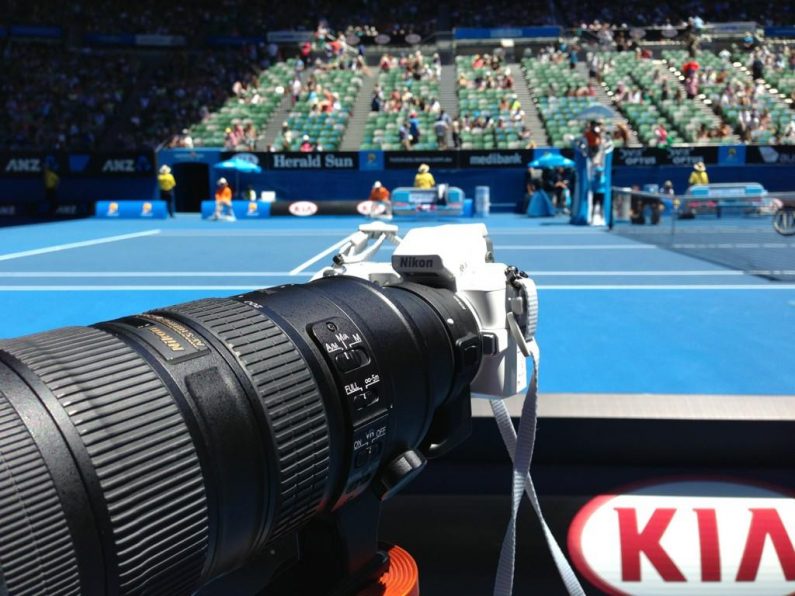
This is a Nikon V2 camera with a 70-200mm lens. Because the V2 has a small sensor the equivalent focal length is about 190-540mm. And this camera can shoot photos at 60 frames per second. Compare that to my usual D4 DSLR which shoots at 10 frames per second and you’ll see why it’s the shape of things to come. These are 12 Megapixel raw files, just like what the Nikon D3 did just four years ago. I’ll post a followup story with some image sequences to show you this camera in action. Here’s the follow up story: https://syd-low.com/2013/02/getting-beyond-12-frames-per-second/